Technical Analysis: LFEX Norway Exporters Salmon Index, 1st June 2026

David Nye - The London Fish Exchange

Published: 1st June 2026

This Article was Written by: David Nye - The London Fish Exchange


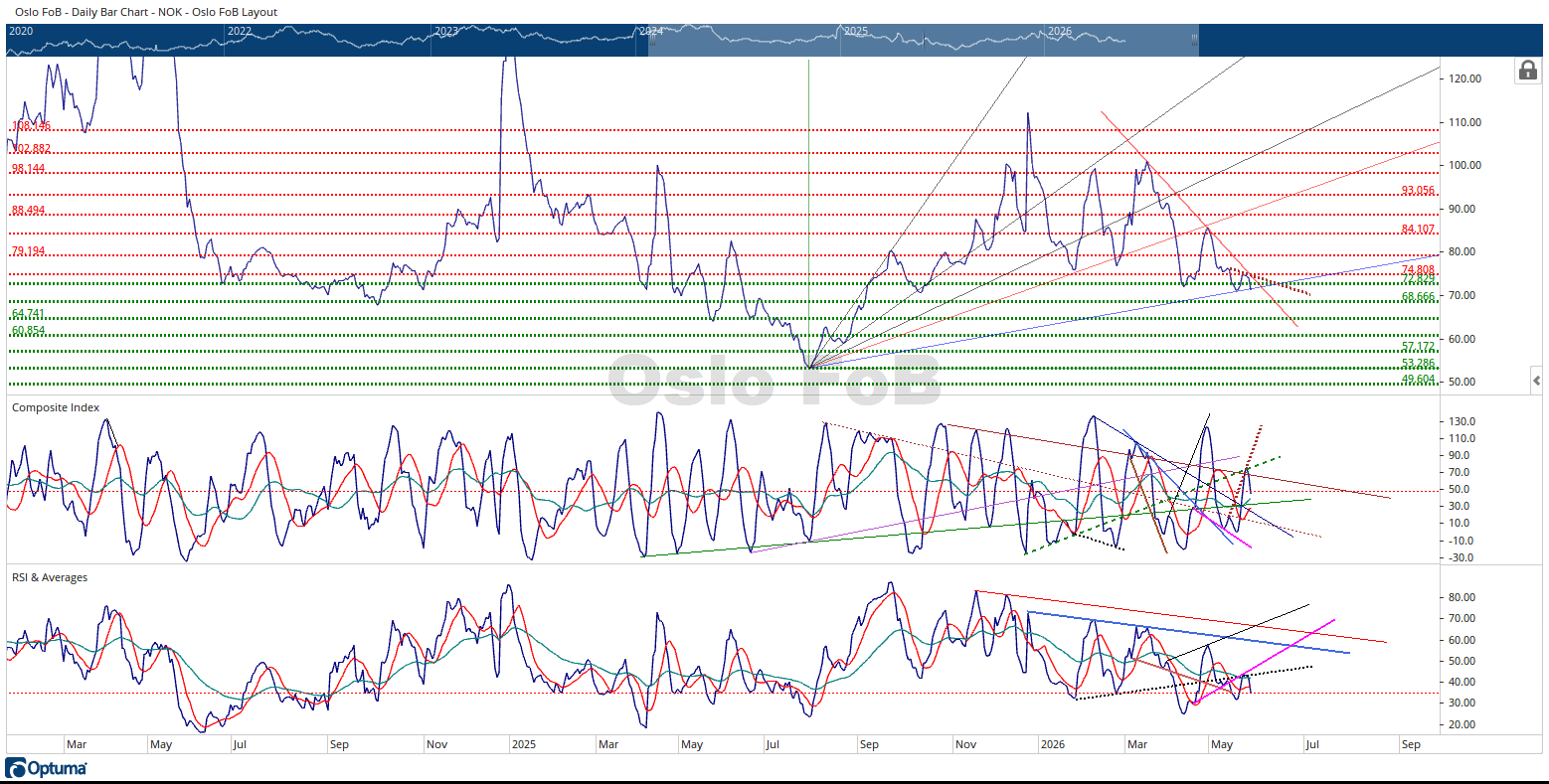
The Oslo FoB Index fell 4.92% during this week of trading to end the week at 71.01 NOK. I made several adjustments to the horizontal resistance zones for this week’s update.

The Oslo FoB Index is challenging the blue upward sloping trendline that originates from last summer seasonal price lows. This blue trendline was respected by the Oslo FoB Index on its first challenge. I also added a lighter shade of a red downward sloping trendline that connects the two of the three previous price highs. The most recent rally came close to testing the underside this red trendline. I also added a brown dotted trendline the price chart connecting the two most recent price highs.

The Oslo FoB Index continues to make lower price lows and lower price highs. The close this week of 71.01 NOK is below the previous low of 71.13 NOK from 5.19.26. The most recent price high was also a lower price high then its previous price high. I know I mention this issue almost weekly but it’s important in defining the trend of the Oslo FoB Index. In bear markets, the trend of lower price lows and lower price highs is expected.

The first thing I noticed on the chart this week is how much the Composite Index has rallied vs the rally in the Oslo FoB Index. I added a brown dotted upward sloping trendline to the Composite Index to show the bearish divergence with the Oslo FoB Index. The Composite Index is more oversold and lower prices. The Composite Index has used its current displacement within the available history. The last occurrence of this happened on December 30, 2025. This signal has already occurred on May 26, 2026.

I can argue that we are now seeing bullish divergence in the Composite Index and the RSI. The Composite Index and the RSI are at higher displacements while the Oslo FoB Index is at a lower price low. I’m referencing the time between May 19 and May 28, 2026. I would not assign a high probability of this signal working but it’s on the chart. I didn’t add a trendline on the Composite Index and the RSI panes to display this signal.

The RSI is also showing the same bearish divergence as the Composite Index. The RSI is more oversold at lower prices. The existing pink trendline on the RSI pane shows this divergence. The RSI is also not operating with in a bullish displacement range. Like the Composite Index the RSI is also showing short term bullish divergence between May 19 and May 28, 2026.

In summary, the Oslo FoB Index is continuing to make lower price lows and lower price highs. The definition of a downtrend. I know there is some conflicting information within this update. There have been many updates in the past five years that had conflicting signals. I would lean on the trend in prices for the answer. In my opinion, price is the most important factor in this type of analysis. The data within the price history the Oslo FoB Index is suggesting prices will continue to trend lower for a couple of months. This doesn’t mean that Oslo FoB Index can’t rally in price from time to time even during a downtrend in prices.

  About This Analysis

About David Nye

David is a Senior Vice President in investment advisory with over 30 years of experience.

Based in Minnesota, USA he has a long history in technical analysis across a range of markets. David brings his experience to provide an independent insight into potential salmon pricing based on LFEX and DataSalmon data.

What is Technical Analysis?

Technical Analysis is used to try and identify price trends in the future. Analysts believe that by using factual past information (trading activity and price changes) it is possible to identify future price movement trends and is quite prevalent in commodity and forex markets but can be applied to any product.

Technical Analysis has been developing for over a century, and there are now hundreds of patterns and signals that have been created. They are often used in conjunction with other forms of research and analysis to help formulate, or support pricing trend opinions.

Purpose of the Analysis?

To provide an independent data-driven view of market pricing trends in the short and medium-term. As a potential tool, for users to access future pricing trends based on LFEX/DataSalmon derived market data.

How Does it Work?

On a regular basis (weekly), David will provide his independent analysis of LFEX and DataSalmon pricing data. The output will be to provide pricing trends based on the most up to date pricing received.

The analysis will show the expected trends and potential (price) levels, as well as other markers – for example, higher or lower price triggers that would affect the analysis of the trend – and what this might mean. It is data-driven, and will not, and does not, account for any other fundamental analysis, or weather or biological events for example. This is the same for any commodity product technical analysis.

Disclaimer

All information provided contains no guarantee whatsoever, especially of completeness, accuracy, timeliness or of the results obtained from the use of this information, and is provided without warranty of any kind, expressly or implied. In no event will, LFEX Ltd or DataSalmon, its member firms, or the partners, directors, officers, owners, agents or employees thereof be liable to you or anyone else for any decision made or action taken in reliance on the information or for any consequential, special or similar damages, even if advised of the possibility of such damages. In no event and under no legal or equitable theory, whether in tort, contract, strict liability or otherwise, shall LFEX Ltd or DataSalmon be liable for any direct, indirect, special, incidental or consequential damages arising out of any use of the information contained herein, including, without limitation, damages for lost profits, loss of goodwill, loss of data, work stoppage, the accuracy of results, or computer failure or malfunction